Surface area and porosity are important physical properties that influence the quality and utility of many materials and products. Therefore it is critically important that these characteristics be accurately determined and controlled. Likewise, knowledge of surface area and especially porosity often are important properties in understanding the formation, structure, and potential application of many natural materials.
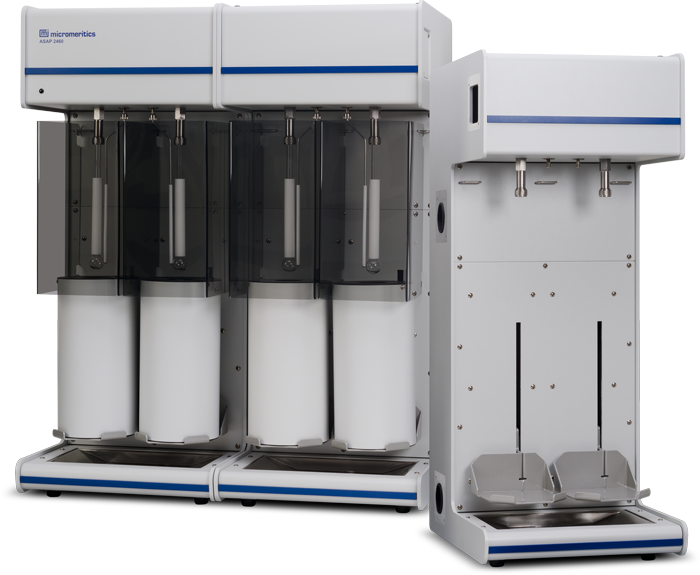
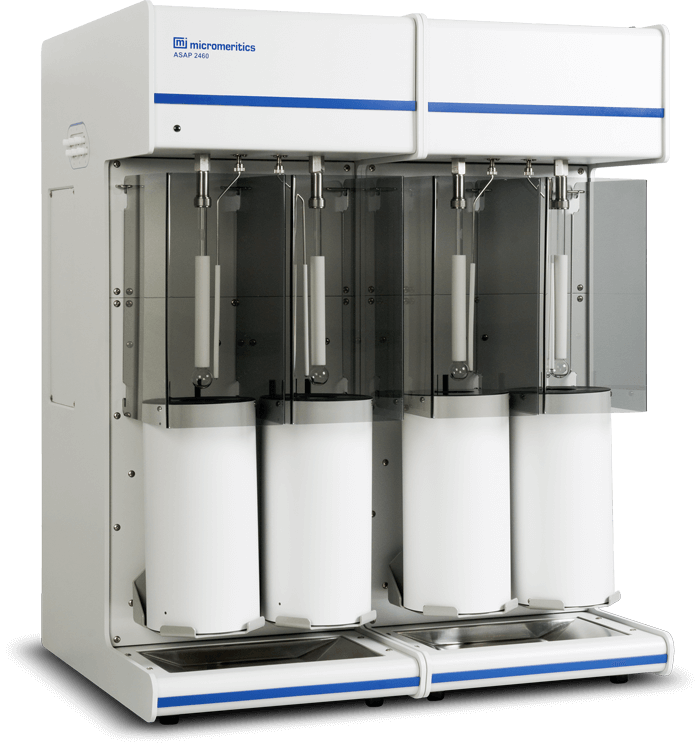
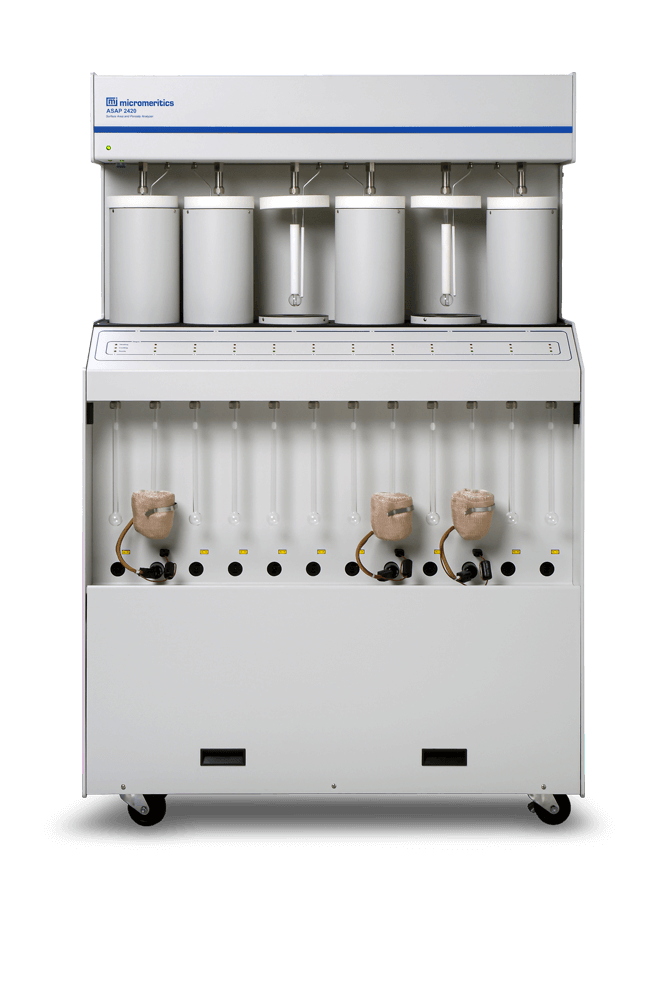
High Performance and High Sample Throughput. The automated Micromeritics® ASAP® 2425 surface area and porosimetry system is designed to help busy laboratories expand their workflow while providing highly accurate and precise surface area and porosimetry data. High performance, versatile analysis, and sample preparation systems are included in the same instrument.
In addition to the standard ASAP 2425 and ASAP 240, low surface area krypton and micropore models are available. Low surface area (krypton) model includes the addition of a 10 mmHg transducer and permits accurate measurement of very low surface area materials (< 1 m2 /g). The micropore model includes the addition of a 1 mmHg transducer which extends the low pressure measurement capabilities and allows enhanced performance for characterizing microporous materials. The transducer also increases pressure resolution in the range necessary for micropore analysis.
Innovative MicroActive Software
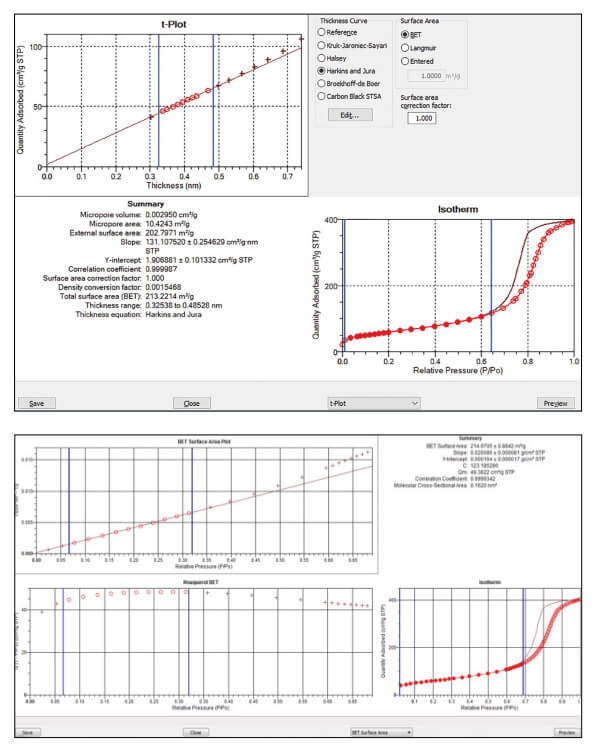
Micromeritics’ innovative MicroActive software allows users to interactively evaluate isotherm data. Users can easily include or exclude data, fitting the desired range of experimentally acquired data points using interactive, movable calculation bars. Isotherms can be viewed on either a linear or logarithmic scale.
(when appropriate to the analysis performed)
Surface area and porosity play major roles in the purification, processing, blending,...
+Surface area and porosity affect the curing and bonding of greenware and...
+Knowledge of surface area, total pore volume, and pore size distribution is...
+Surface area and porosity must be optimized within narrow ranges to accomplish...
+The wear lifetime, traction, and performance of tires are related to the...
+The active surface area and pore structure of catalysts influence production rates....
+The surface area of a pigment or filler influences the gloss, texture,...
+The burn rate of propellants is a function of surface area. Too...
+Controlling the porosity of artificial bone allows it to imitate real bone...
+By selecting high surface area material with carefully designed pore networks, manufacturers...
+Surface area is often used by cosmetic manufacturers as a predictor of...
+Surface area and porosity of heat shields and insulating materials affect weight...
+Porosity is important in groundwater hydrology and petroleum exploration because it relates...
+Nanotube surface area and microporosity are used to predict the capacity of...
+Fuel cell electrodes require high surface area with controlled porosity to produce...
+| ASAP 2425 | ASAP 2460 |
| Voltage | 100/115/230 VAC (± 10%) | 100/115/230 VAC (± 10%) |
| Frequency | 50 or 60 Hz | 50 or 60 Hz |
| Power | 800 VA, exclusive of vacuum pumps, which are powered separately | 800 VA, exclusive of vacuum pumps, which are powered separately |
| ASAP 2425 | ASAP 2460 |
| Temperature | 10 to 30 °C operating, -10 to 55 °C storage or shipping |
10 to 30 °C operating, -10 to 55 °C storage or shipping |
| Humidity | Up to 90% relative (non-condensing) for instrument. | Up to 90% relative (non-condensing) for instrument. |
| ASAP 2425 | ASAP 2460 |
| Analysis System | 6 sample ports, each with a constantly monitored saturation pressure port | 2, 4, or 6 sample ports (for krypton analysis, one sample port is used for dosing), each with a constantly monitored saturation pressure port |
| Degas System | 12 degas ports, each with independently controlled heating mantle | - |
| ASAP 2425 | ASAP 2460 |
| Manifold Temperature Transducer | Type: Platinum resistance device (RTD) Accuracy: ±0.10 °C by keyboard entry Stability: ±0.10 °C per month | Type: Platinum resistance device (RTD) Accuracy: ±0.10 °C by keyboard entry Stability: ±0.10 °C per month |
| Manifold Pressure Transducer | Range: Vacuum to 950 mmHg operating: 1000 mmHg maximum 10 mmHg added for krypton option 1 mmHg for micropore optionResolution: 1000 mmHg Transducer: 0.01 mmHg 10 mmHg Transducer: 0.0001 mm 1 mmHg Transducer: 0.00001 mmAccuracy: 1000 mmHg Transducer: within 0.1% FS 10 mmHg Transducer1 : within 0.15% of reading 1 mmHg Transducer2 : within within 0.12% of reading |
Range: 0 to 950 mmHg operating: 1000 mmHg maximum 0 to 10 mmHg added for Krypton option Resolution: 1000-mmHg Transducer: 0.001 mmHg 10-mmHg Transducer1: 0.00001 mmHg 1-mmHg Transducer**: 0.000001 mmHg Accuracy: 1000-mmHg Transducer: within 0.15% of reading 10-mmHg Transducer1: within 0.15% of reading 1-mmHg Transducer2: within 0.12% of reading |
| Sample Port Transducer and Po Port Transducers | Range: 0 to 950 mmHg Resolution: 0.01 mmHg Accuracy: ±0.1% Full Scale |
| Vacuum Gauge | Type: Thermocouple Range: 0.001 to 1 mmHg |
Type: Thermocouple Range: 0.001 to 1 mmHg |
| ASAP 2425 | ASAP 2460 |
| Height | 159 cm (62.5 in.) | 94 cm (37 in.) |
| Width | 103 cm (40.5 in.) | 38 cm (15 in.) |
| Depth | 51 cm (20.2 in.) | 59 cm (23 in.) |
| Weight | 160 kg (350 lb) | 54 kg (119 lb) |
| ASAP 2425 | ASAP 2460 |
| Nitrogen System Pumps | 2 oil-based pumps: 1 analysis, 1 degas 4 pumps (optional): 2 oil-free (1 analysis, 1 degas), 2 high vacuum (1 analysis, 1 degas) |
Nitrogen: Oil-sealed pump |
| Krypton & Micropore Pumps | Oil-based mechanical pump: 5 x 10⁻³ mmHg ultimate vacuum Oil-free and high vacuum pump: 3.8 x 10⁻⁹ mmHg ultimate vacuum3 |
Krypton & enhanced micropore option: High-vacuum pump |
| ASAP 2425 | ASAP 2460 |
| Capacity | 12 degas ports | - |
| Vacuum Control | Selectable target pressure controls switchover from restricted to unrestricted evacuation | - |
| Evacuation | Selectable evacuation rate from 1.0 to 50.0 mmHg/s | - |
| Manifold Pressure Transducer | Range: 0 to 950 mmHg Resolution: 0.01 mmHg Accuracy: ±0.1% Full Scale |
- |
| Vacuum Transducer | Type: Thermocouple Range: 0.001 to 1 mmHg |
- |
| Titled Backfill Gas | User-selectable at dedicated port, typically nitrogen or helium | - |
| Temperature Control | Temperature Range: Ambient to 450 °C (Programmable) Temperature Control: 1 ramp during evacuation phase, 5 additional selectable ramps during heating phase Selection: Digitally set, 1 °C increments from computer Accuracy: Deviation less than ±10 °C of set point at the sensing thermocouple embedded in the heating mantle |
- |
Request a quote or talk to an expert for more information