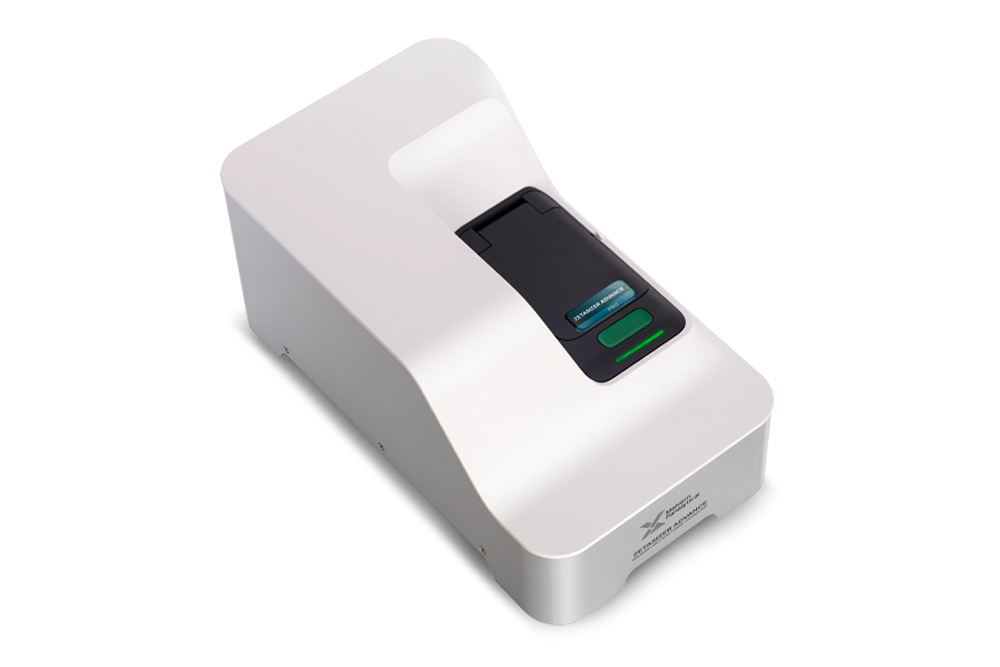

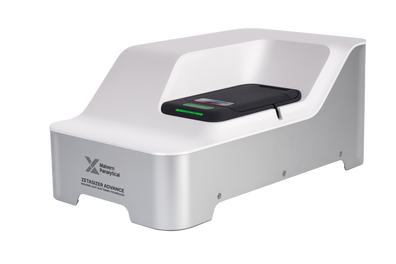
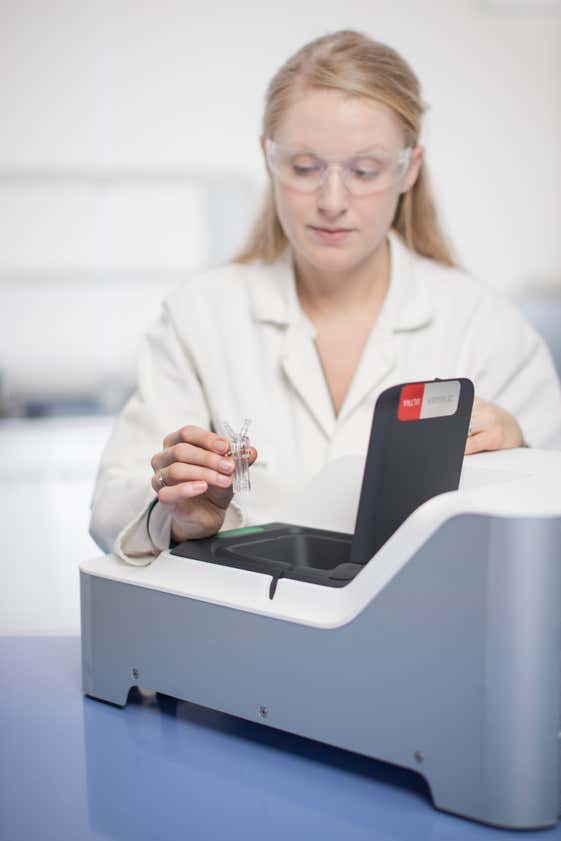
The Zetasizer Lab is the perfect entry-level system. The Zetasizer Lab offers traditional 90-degree side-scatter size measurements but still offers enhanced features.
It incorporates Adaptive Correlation, M3-PALS and constant current zeta mode as well as our extended size range analysis when used with ZSU1002 capillary cell.
The Zetasizer Lab also ships with ZS Xplorer, our easy-to-use analytical software. ZS Xplorer offers instant feedback on data quality, and guidance on how to improve your results.
Available in Blue Label and Red Label variants:

Works with OmniTrust: Malvern Panalytical's compliance solution for the regulated environment
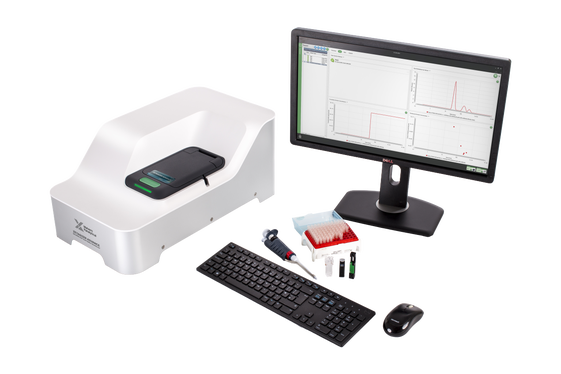
DLS analysis : particle size measurements from 0.3 nm to 10 μm
Zeta potential of nanoparticles and colloids using M3-PALS analysis and constant current zeta mode
Molecular weight using Static Light Scattering at 90°
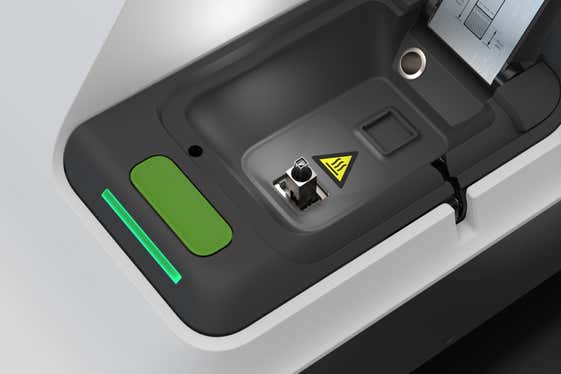
Supports use of Low Volume Disposable Capillary Cell for size measurements in sample volumes as low as 3 μL
Extended size range analysis offers improved accuracy for particle sizes above 1 μm, and indicative results above 10 μm (using ZSU1002 Low Volume Disposable Sizing Cell)
On-site upgradeability to either Zetasizer Pro or Zetasizer Ultra models
| Zetasizer Ultra | Zetasizer Pro | Zetasizer Lab | |
|---|---|---|---|
| Size Measurement Principle | Non-Invasive Back Scatter (NIBS)
Dynamic Light Scattering Dynamic Light Scattering (90° and 13°) Multi-Angle Dynamic Light Scattering (MADLS®) |
Non-Invasive Back Scatter (NIBS)
Dynamic Light Scattering |
Classical 90° Dynamic Light Scattering |
| Zeta Measurement Principle | ELS with M3-PALS and Constant Current Zeta Mode | ELS with M3-PALS and Constant Current Zeta Mode | ELS with M3-PALS and Constant Current Zeta Mode |
| Molecular Weight and B22 | Static Light Scattering (90° and 173°) | Static Light Scattering (173°) | Static Light Scattering (90°) |
| Optical Filter Wheel (Fluorescence/DDLS) | Yes | Yes | No |
| Low Volume Disposable Sizing Cell with Extended Size Analysis Support | Yes | No | Yes |
| MADLS® (High Resolution DLS) | Yes | No | No |
| MADLS® - Particle Concentration/Titer | Yes2 | No | No |
| 21 CFR Part 11 compliant software | Optional via Omnitrust | Optional via Omnitrust | Optional via Omnitrust |
| Size | |||
| Range2 | 0.3 nm to 10 μm | 0.3 nm to 10 μm | 0.3 nm to 10 μm |
| Minimum Volume | 3 μL | 12 μL | 3 μL |
| Zeta potential | |||
| Size Range | 3.8 nm to 100 μm | 3.8 nm to 100 μm | 3.8 nm to 100 μm |
| Minimum Volume3 | 20 μL | 20 μL | 20 μL |
1 Red Label only
2 10 um by default. Option to extend for Zetasizer Lab and Zetasizer Ultra coming soon
3 Patented Diffusion Barrier method in capillary cell
The Zetasizer Advance Range is suitable for a wide range of applications, including:
Sizing of colloidal silica is a critical requirement. This is easily and reproducibly measured using the Zetasizer Lab Blue Label.
Titanium dioxide use is wide-ranging. When used in paints or inks, agglomerate or aggregate formation can diminish product performance. The Zetasizer Pro Blue Label, used alongside the MPT‑3 Autotitrator, characterizes the impact of salt concentration on the stability of TiO2 and identifies the most stable pH region.
The strength of ceramics is linked to particle size, and the Zetasizer Ultra Blue Label is ideally placed to measure this. Al2O3 samples are often made of differently-sized particles which can easily be identified using MADLS. In this 0.1% w/v sample, the two particle size populations would not be distinguishable with a single angle DLS measurement.
For protein researchers, early access to characterization data can be a challenge, due to low sample volumes. This is easily overcome using the Zetasizer Lab Red Label with the capillary cell to confirm that samples meet quality requirements and that production and purification processes are optimized.
Photoluminescent C-dots are considered safer alternatives to quantum dots. Measuring fluorescent samples by DLS can be challenging due to additional photons emitted by the fluorophore. Available with NIBS on Zetasizer Pro Red Label, a filter removes this interference to provide accurate and reliable data.
Monitoring viral concentration is important during development and production optimization. By using the Multi-Angle DLS (MADLS) based particle concentration measurement in the Zetasizer Ultra Red Label, both the size distribution and titer of the virus can be measured within a few minutes.
The Zetasizer Advance Range is used in many industries, including:
The Zetasizer Lab is an essential analytical tool for many academic laboratories worldwide, finding use in all applications where particle or molecular size and zeta potential analysis is required. The breadth of applications covered by Zetasizer systems, coupled with tens of thousands of scientific citations, have earned these instruments a central space in many scientific faculties.
Variations in molecule concentration, external temperature, level of agitation and time all impact the stability of biological molecules. Instabilities mainly result in denaturation and aggregation of the molecule through which they can lose their biological function , elicit an immune response and consequently limit its therapeutic viability. Factors affecting therapeutic efficacy and immunogenicity therefore need to be monitored throughout the development pipeline especially at early stages to de-risk the biological drug molecule and limit late-stage failures. The Zetasizer range provides high quality, stability indicating data for biological drug molecules in a short time frame, enabling this measurement to be implemented throughout the development pipeline.
Zetasizer systems are used to analyze particle size and zeta potential to improve the appearance and taste of foods, drinks and flavorings, and optimize dispersion and emulsion stability to extend product shelf life and improve product performance.
Zetasizer measurements of nanoparticle size distribution, dispersion properties, stability and propensity to aggregate are crucial to the design of new nanomaterials. The very large surface area of such materials may result in novel physical and chemical properties, such as increased catalytic activity, improved solubility or unexpected optical or toxicological behavior.
Paint, ink and coating formulations must be stable to keep them in an optimum state over time without change or aggregation. Particle size and zeta potential, measured by the Zetasizer instruments, play important roles in determining a product’s properties, such as dispersibility, color, strength, finish, durability and shelf life.
The correct particle size and zeta potential can help ensure the production of effective therapeutics, delivered safely. Zetasizer systems are used to characterize the stability and quality of dispersions, emulsions and creams, reducing formulation time and speeding new products to market.
High quality and reproducible results can be obtained. Especially, the experiment is easy to use and maintain. For ease of use, one can easily learn to perform after several minutes training. For after-sales care, it did not need to have any maintenance for several years. Thus, we believe that it is good value for money"
Mi Zhou — Sichuan University